
Instructional Media
This course provides the students with the knowledge and skills of selecting and designing the appropriate instructional media for the teaching of English at SMP/SMA/SMK. The materials are the concept of instructional media, the principles of selecting and designing instructional media, printed><nonprinted media, projected><non-projected media, audio-visual media, and low-high technology media. The designed teaching media should be relevant to the principles of the genre-based approach, EFL learners' background, and linguistic input needs.

Textbook Analysis and Material Development
By the end of the study, students will be able to:
- Understand the rationale and various concepts of textbook analysis and evaluation.
- Recognize the benefits of conducting textbook analysis and evaluation.
- Demonstrate objectives of textbook analysis and evaluation
- Analyze critically problems concerning English textbooks written in the EFL settings.
- Select methods of doing textbook analysis and evaluation of various numbers of textbooks available in the market.
- Develop criteria for textbook analysis and evaluation
- Formulate an appropriate design for analyzing and evaluating English learning materials
- Write English learning materials based on results of their analyses and evaluations.

Textbook Analysis and Material Development2020
By the end of the study, students will be able to:
- Understand the rationale and various concepts of textbook analysis and evaluation.
- Recognize the benefits of conducting textbook analysis and evaluation.
- Demonstrate objectives of textbook analysis and evaluation
- Analyze critically problems concerning English textbooks written in the EFL settings.
- Select methods of doing textbook analysis and evaluation of various numbers of textbooks available in the market.
- Develop criteria for textbook analysis and evaluation
- Formulate an appropriate design for analyzing and evaluating English learning materials
- Develop English learning materials for SMP/MTs/SMA/SMK/MA schools

Theories of teaching and methods
This course is designed to introduce some common methods/approaches in teaching English to the students who are going to be teachers of English as a foreign language. Those are Grammar Translation method, Direct method, Audio Lingual method, Suggestopedia, Total physical Response, Society Language learning , Communicative Approach,

THEORIES OF TEACHING AND METHODS
THIS IS TOPIC 6. IT IS RELATED TO A METHOD IS CALLED COMMUNITY LANGUAGE LEARNING
TOEFL PREPARATION COURSE
This course is intended to support English 2 for students of Pharmacy Study Program, Faculty of Medicine. This focuses on TOEFL Preparation to help students to achieve the required score on TOEFL (450) as one of graduation requirements


Translation & Interpreting
A subject introducing the basic theory of translation of different texts and genres, the terms used, and a brief analysis of text as a doorway to a more complex translation practice.
Objectives:

Vocabulary Building (HUSNUL LAIL)
Students are expected that they are able to enrich their English vocabulary and comprehend how to construct it well in both of spoken and written English.
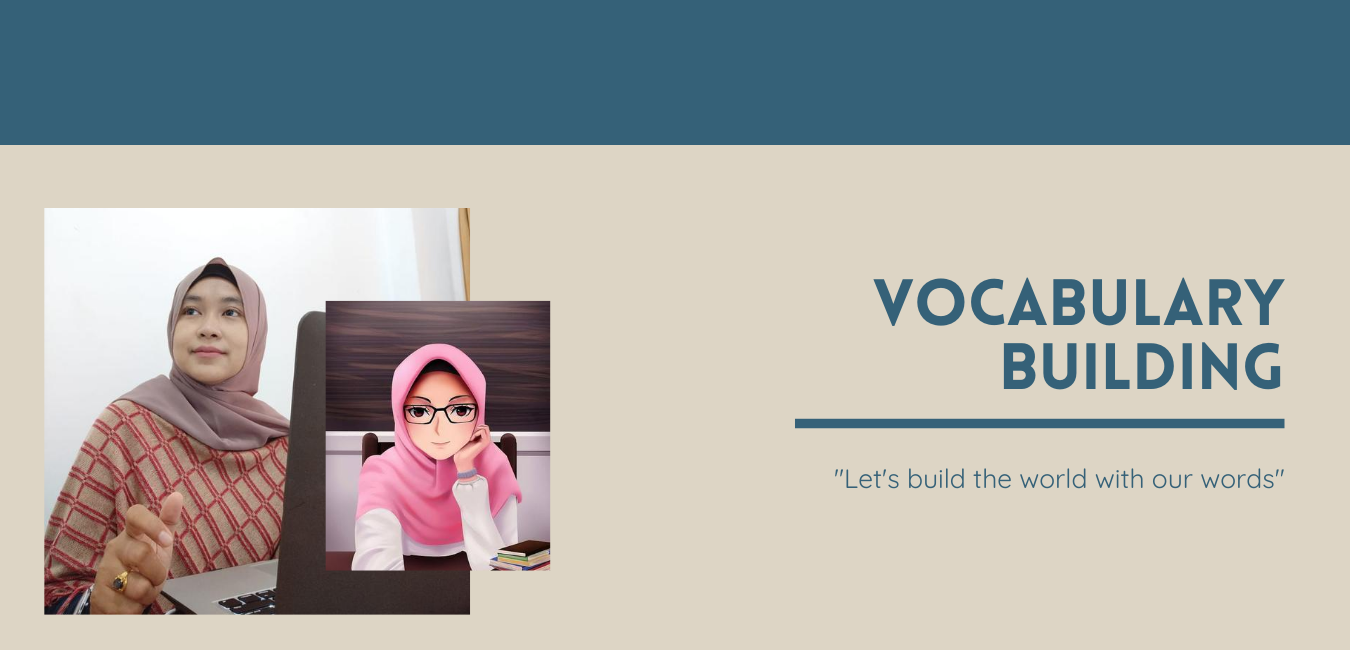
VOCABULARY BUILDING Mrs. KHKH 2020/2021
Course Description:
This course aims to provide students an opportunity to explore and experience basic concepts of vocabulary building (part of speech, words with prefixes, words with suffixes, words with both prefix and suffix, antonym, synonym, homophone, homograph, and topical vocabulary) and the use of vocabulary in context. Within 16 meetings, the students will do individual work, pair work, as well as group work covering text analysis, vocabulary games and challenges, and some exercises in word building and sentence formation in written or oral context.
Course Objectives:
By the end of the course, after actively participating all meetings, participants are expected to be able to :
- Demonstrate adequate ability to identify and use part of speech in context.
- Demonstrate adequate ability to identify and use prefixes, suffixes, and prefixes-suffixes, antonym, synonym, Homophone, and homograph in context.
- Demonstrate adequate ability to put new vocabulary in correct sentences or short written or oral texts
- Demonstrate awareness to enrich their vocabulary from listening or reading activities.