
English Morphology
This course is designed to
provide students with the ability to analyse English words (word formation in
English). The topics will cover the basic consepts of morphology, types of
morphems, representing word structure (internal structures of words),
morphological process (derivation and inflection), and some morphological
phenomena in English. Dicsussions and reflections will be dominantly used to
strengten the students’ comprehension of the concepts along with the reports,
paper, and poster presentations given at the end of every topic (competency).
English Morphology
This course is designed to
provide students with the ability to analyse English words (word formation in
English). The topics will cover the basic consepts of morphology, types of
morphems, representing word structure (internal structures of words),
morphological process (derivation and inflection), and some morphological
phenomena in English. Dicsussions and reflections will be dominantly used to
strengten the students’ comprehension of the concepts along with the reports,
paper, and poster presentations given at the end of every topic (competency).
English Morphology
This course introduce students to the structure of english word :ormation and some inflectional processes in the language. The course also make a general cross linguistics corelates in the languages typology
English Morphology
This
course is designed to provide students with the ability to analyse English
words (word formation in English). The topics will cover the basic consepts of morphology,
types of morphems, representing word structure (internal structures of words),
morphological process (derivation and inflection), and some morphological
phenomena in English. Dicsussions and reflections will be dominantly used to
strengten the students’ comprehension of the concepts along with the reports,
paper, and poster presentations given at the end of every topic (competency).
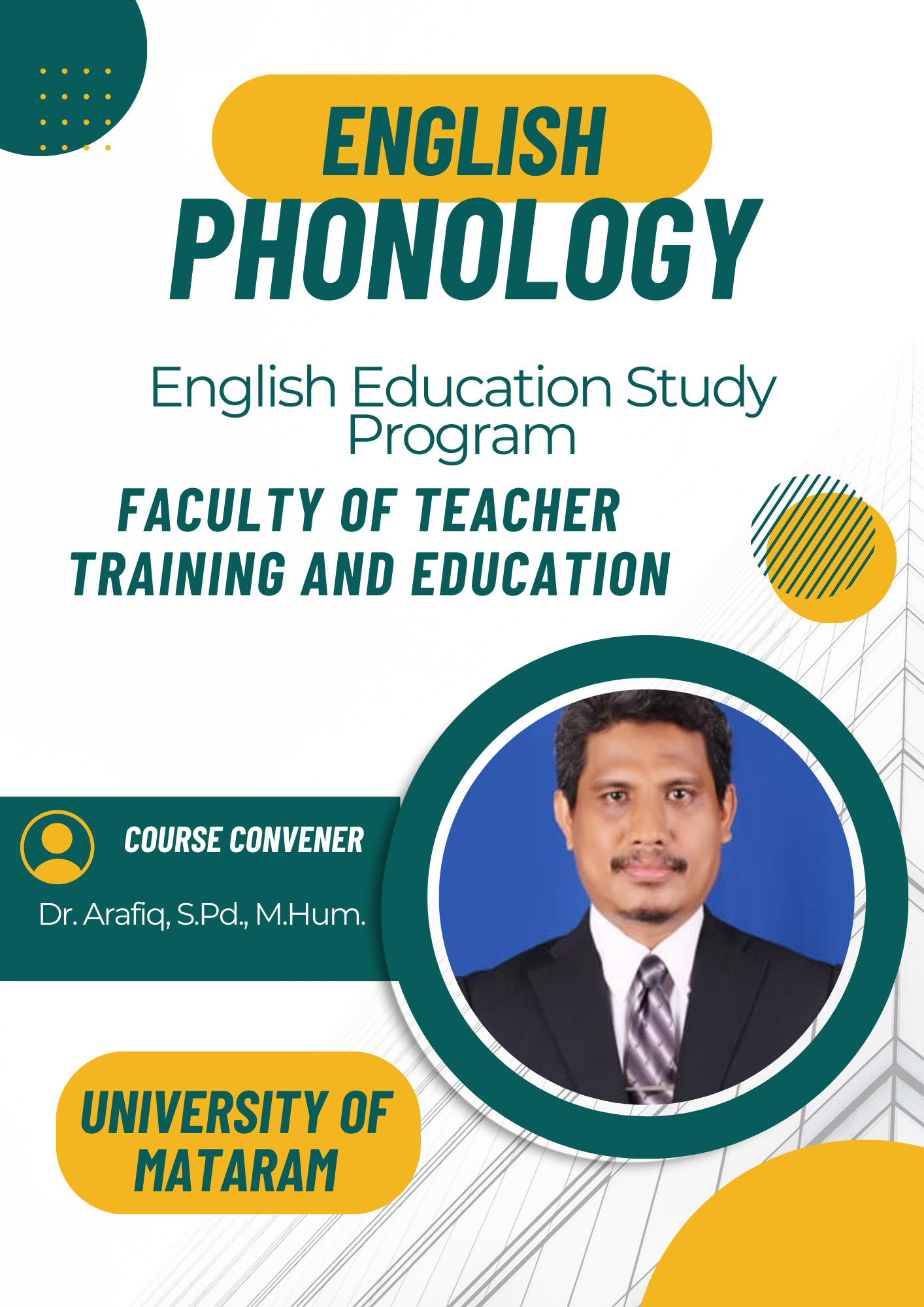
English Phonolgy
English Phonology is designed to provide students with a theoretical understanding about phonetics and phonology of English. The course will involve lectures to overview the basic concept of phonetics and phonology to individual and group works in order to build their analytical competence of phonological rules and sounds production. The materials will include sounds, spelling, symbols, organs of speech, airstream mechanism (pronunciation), phonetic features, articulatory features, vowel and consonants, prosodic and suprasegmental phonology, syllable and syllabification, phonemes, phonetics, place of articulation and manner of articulation. The assessment will be based on students’ achievements on assignments and tests.

English Syntax
This course is designed to provide students with
the ability to analyse Syntax of English based on structural/traditional and
functional/transformational approaches. The topics will cover the basic properties
of syntax, representing sentence structures, parts of speech, phrases and
constituents, sentences and clauses, movements, grammatical functions, and valencies.
Dicsussions and reflections will be dominantly used to strengten the students’
comprehension of the concepts along with the reports, paper, and poster
presentations given at the end of every topic (competency).
IB INTENSIVE LISTENING (YBL)
This course is designed to help students develop bottom-up processing skills. It focuses on the students’ awareness on language form and that the aim of the class activities is to increase the students’ knowledge of the differences in sounds, structures, and the lexical choices, all of which affect the meaning. The class activities allow the students to work closely on certain segments of texts which are carefully selected by the teachers. The activities also allow the students to listen carefully to how sounds fit together in words, how a certain new word is used and how contextual clues can be used to guess its meaning. Thus, this Intensive Listening course is characterized as listening for precise sounds, words, phrases, grammatical units and specific/detailed information.
INTENSIVE COURSE
After attending all
required lectures, actively participating in every class meeting and working
all the prepared tasks with task based learning Approach (individual,
pair-work, and group-work discussion), the learners are expected to be able to integrate
all four skills: listening, speaking, reading, and writing in acceptable ways.
In addition, work on grammar and vocabulary is also found throughout the
materials prepared.
Intensive English Course (husnul Lail)
LEARNING OBJECTIVES :
After attending all required meetings, participating actively in the discussion, and doing all tasks assigned in this course, the students are expected to be competent not only at the four skills in English including speaking, listening, writing, and grammar, but also at pronunciation and vocabulary. Those skills are in form of basic levels as the requirement to have the further higher courses.
Intensive English Course (HUSNUL LAIL)
LEARNING OBJECTIVES :
After attending all required meetings, participating actively in the discussion, and doing all tasks assigned in this course, the students are expected to be competent not only at the four skills in English including speaking, listening, writing, and grammar, but also at pronunciation and vocabulary. Those skills are in form of basic levels as the requirement to have the further higher courses.